The Sensory CORDS Framework for Adaptive Neurointegration

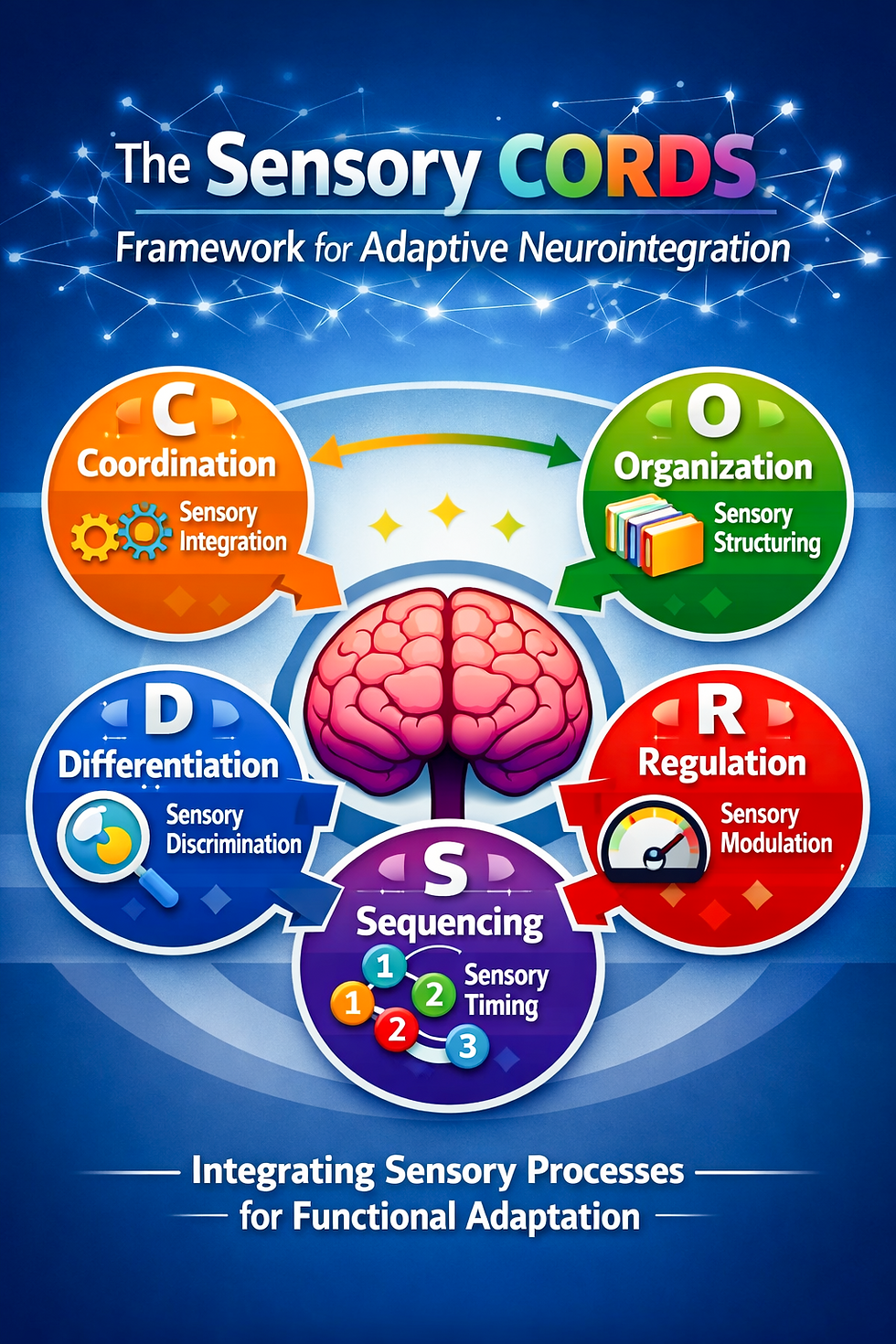
Although sensory integration has long been discussed in clinical and educational contexts, one concept remains under‑recognized within neuroscience: Sensory CORDS.
All sensory experience begins with core sensation - the nervous system’s initial, measurable registration of physical stimuli. Traditionally, core sensation has been difficult to quantify objectively. However, emerging technologies such as the MAMAY Digitizer now enable the extraction of core sensory signatures using AI‑driven, data‑analytic modeling.
This system identifies the fundamental sensory properties of any material or mass through quantifiable, science‑based metrics, providing an unprecedented window into the sensory inputs that initiate neural processing.
From this foundation of core sensation, CORDS describes how the nervous system transforms raw sensory data into complex, adaptive neurofunctional processes. The acronym represents five interdependent mechanisms:
➧ Coordination - synchronizing multisensory streams to achieve coherent perception
➧ Organization - structuring sensory data into usable neural patterns
➧ Regulation - modulating intensity, attention, and arousal for optimal responsiveness
➧ Differentiation - discriminating between sensory qualities and sources
➧ Sequencing - ordering sensory‑motor events to enable predictive, goal‑directed behavior
Together, these mechanisms form the synergy underlying effective sensory‑motor integration. Rather than functioning as isolated systems, sensory modalities interact dynamically through the CORDS processes, allowing the brain to weave perception, movement, emotion, and cognition into a unified adaptive network.
By situating sensory synergy within a neurointegrative framework, Sensory CORDS provides a powerful lens for examining both typical development and sensory‑processing disorders. It bridges clinical observation with neural systems theory and advances our understanding of how measurable sensation becomes adaptive action.
The integration of MAMAY Digitizer analytics with the CORDS model opens a new frontier:
linking objective sensory data with neurofunctional processing, enabling more precise research, assessment, and environmental design grounded in the true sensory properties of the world.


Comments